Executive Summary: The State of California Auto Tinting
Before diving into the complex thermal dynamics of modern window films or car tints, we must establish a baseline. Operating a vehicle in the Golden State requires a strict adherence to regulatory codes balanced against the desperate need for thermal rejection. Below is a rapid-fire breakdown of the critical metrics governing automotive window tinting today.
| Aspect | Technical Detail | Practical Application |
|---|---|---|
| Front Side Windows | Minimum 70% VLT (Visible Light Transmission) | Must allow 70% of light in; heavily limits aftermarket film choices. |
| Rear & Back Windows | Any darkness permitted (0% VLT allowed) | Requires dual side view mirrors if rear window is tinted. |
| Windshield | Transparent strip top 4 inches (or AS-1 line) | Reduces glare without compromising primary forward visibility. |
| Primary Technology | Nano-Ceramic vs. Carbon vs. Dyed | Ceramic offers highest TSER (Total Solar Energy Rejection) without signal block. |
Last August, a client maneuvered a pristine 2022 Porsche 911 into my installation bay. The ambient outside temperature sat at a blistering 104 degrees in the San Fernando Valley, yet the interior of that German masterpiece felt like a commercial kiln. The factory glass, despite its premium pedigree, was acting as a magnifying lens focused directly on the porous leather dashboard. I pulled out my infrared thermometer. The surface measured a staggering 168 degrees Fahrenheit. It was actively degrading. This specific interaction highlights a stark reality: driving without high-performance window film on the West Coast is a localized form of vehicular self-sabotage.
Why You Need a Premier Car Tints Service in California
We often categorize window tint as a purely aesthetic modification—a fast track to an aggressive, clandestine aesthetic. The reality is far more clinical. High-grade window film is active armor against a hostile solar environment. Factory glass provides minimal defense against Ultraviolet A (UVA) rays, the specific bandwidth responsible for both material fading and long-term dermal damage.
I have spent over a decade measuring ambient interior temperatures across hundreds of vehicle makes and models. The degradation pattern is remarkably consistent. First, the dashboard outgasses, leaving a hazy chemical residue on the interior glass. Next, the leather loses its essential oils, leading to micro-cracking along the bolsters. Eventually, the structural integrity of the adhesives holding the headliner together fails completely. A specialized application prevents this chain reaction entirely.
Beyond the preservation of high-end upholstery, there is a profound human element. Commuting on the 405 freeway subjects drivers to asymmetrical solar radiation. The left side of the face and arm absorbs a massive dose of UVA radiation daily. Medical literature increasingly points to this phenomenon when diagnosing asymmetrical skin damage. Reviewing clinical studies on automotive UV exposure reveals a startling correlation between left-side facial melanomas and daily driving habits. Premium films reject 99.9% of these harmful rays, functioning essentially as a permanent, high-SPF sunblock.
Decoding the Legalities: California Window Tint Regulations
Securing a dark, aggressive look is tempting, but the California Highway Patrol does not operate on aesthetic leniency. The regulatory landscape here is notoriously strict, engineered primarily to ensure officer safety during traffic stops. Understanding these statutes separates a flawless automotive upgrade from a rolling probable-cause generator.
The cornerstone of the law revolves around Visible Light Transmission (VLT). This metric defines the exact percentage of visible ambient light that successfully passes through the glass and film combination. According to California Vehicle Code Section 26708, the front side windows must maintain a minimum of 70% VLT. This is where many novice installers fail their clients. They will apply a 70% film directly over factory glass, ignorant of the fact that standard automotive glass already blocks roughly 20% to 30% of light. Compounding these values drastically lowers the total VLT, dropping the final reading into illegal territory and guaranteeing a fix-it ticket.
Conversely, the rear hemisphere of the vehicle—everything behind the driver’s B-pillar—is virtually unregulated regarding darkness, provided the vehicle possesses functioning left and right side mirrors. You can practically paint the rear windows black if you desire. Windshields remain strictly off-limits for full-face tinting unless the film is entirely clear and medically exempted, though a non-reflective glare strip is legally permissible down to the AS-1 manufacturer line.
The Physics of Heat Rejection: Not All Films Are Equal
The industry is saturated with cheap, dyed polyester films. These entry-level products function by simply absorbing solar energy. Over a brief period—often just a single grueling West Coast summer—the UV radiation breaks down the fragile chemical dyes. The film turns a hideous shade of purple, bubbles uncontrollably, and loses all functionality. I refuse to let these inferior plastics touch a vehicle.
True thermal defense relies on advanced materials science, specifically nano-ceramic technology. These films utilize a complex, multi-layer PET (polyethylene terephthalate) substrate infused with microscopic, non-conductive particles. Typically formulated from advanced composites like titanium nitride, these nanoparticles act as an impenetrable barrier to infrared radiation (IR)—the specific wavelength responsible for the sensation of heat.
I recently ran a controlled bench test in the shop. We placed a 500-watt heat lamp three inches from a pane of bare glass and another pane treated with an 80% VLT nano-ceramic film. The bare glass allowed severe heat transfer, raising the receptor surface to 140 degrees in minutes. The ceramic-treated pane, despite being almost entirely transparent, kept the receptor at a comfortable 82 degrees. Furthermore, because these ceramic particles are non-metallic, they cause zero signal attenuation. Your GPS, cellular networks, and toll transponders operate flawlessly.
Evaluating the Best Car Tints Service in California
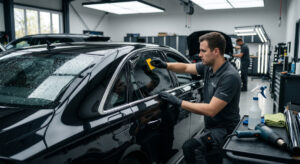
Identifying a master technician requires looking past flashy social media marketing. The true mark of elite craftsmanship lies in the rigorous preparation and the environment of the installation bay itself. Atmospheric contamination is the enemy of a flawless application. A rogue speck of dust or a microscopic stray fiber will forever sit suspended between the glass and the film, creating a glaring visual imperfection.
Top-tier shops maintain climate-controlled, sealed environments specifically to mitigate airborne particulates. They utilize advanced slip solutions—a precise ratio of surfactants and ultra-pure distilled water—to allow the film to glide perfectly into position before squeegeeing the moisture out. When sourcing a reliable car tints service in California, I look for technicians who meticulously file the top edges of roll-down windows. This technique involves shaving the excess film flush with the glass edge, creating a seamless, factory-dyed appearance that prevents premature peeling.
NextGen Car Audio and Tint serves as a prime example of this obsessive methodology of car tints. Their technicians understand the complex geometry of modern vehicles. Take the rear window of a Tesla Model 3, for instance. It is a massive, sweeping compound curve that terrifies novice installers. Amateurs will attempt to splice two pieces of film together, leaving a hideous horizontal seam directly in the rearview mirror’s line of sight. Master technicians utilize high-temperature heat guns to shrink a single, monolithic sheet of film exactly to the glass’s curvature before the liner is ever removed.
Thermal Dynamics and Vehicle Efficiency
There is a hidden mechanical benefit to aggressive infrared rejection: significant reduction of the vehicle’s air conditioning load. Modern automotive compressors consume a substantial amount of engine torque or, in the case of Electric Vehicles (EVs), battery amperage. By drastically lowering the interior ambient temperature, the climate control system reaches its target setpoint much faster and cycles less frequently.
Analyzing vehicle cooling efficiency data published by federal energy researchers highlights the parasitic drag that auxiliary cooling systems place on an engine. In traditional internal combustion engines, a heavy AC load can reduce fuel economy by up to 25% during short, urban trips. For EV owners, the stakes are even higher. I’ve spoken with numerous Tesla and Rivian drivers who noticed a measurable increase in their highway range simply because their cabin cooling systems weren’t running at maximum capacity during daytime travel. Investing in high-grade window film essentially pays dividends at the charging station and the fuel pump.
Installation Mastery: The Hallmark of Elite Window Tint Services in CA
The actual curing process separates impulsive consumers from educated automotive enthusiasts. After a professional applies the film, a residual layer of moisture remains trapped beneath the substrate. In the dry, arid heat of the West Coast, this moisture typically evaporates over three to five days through a process called outgassing. During this crucial window, the film will appear slightly cloudy, and small water pockets may form. car tints Amateurs often panic and attempt to press these out manually, irreparably scoring the scratch-resistant topcoat.
Patience is mandatory. Once fully cured, the adhesive cross-links with the glass matrix, forming a semi-permanent bond. This structural integrity offers a final, critical advantage: shatter resistance. In the event of a side-impact collision or a targeted smash-and-grab attempt, the multi-layered PET substrate holds the shattered tempered glass firmly in place. While it will not prevent a determined intrusion entirely, it drastically increases the time and effort required to breach the cabin, often deterring opportunistic theft.
Securing the right thermal protection strategy elevates the entire driving experience. It protects your skin, preserves your interior architecture, increases your fuel efficiency, and fundamentally changes how your vehicle handles the relentless coastal sun. Demand meticulous preparation. Insist on nano-ceramic technology. Verify the credentials of your chosen technicians. Your daily commute deserves nothing less than absolute perfection.
for the best car tints service in California visit Us at : 120 w lincoln ave, Orange, California 92865
or Contact us online by your Phone : 714-336-1630