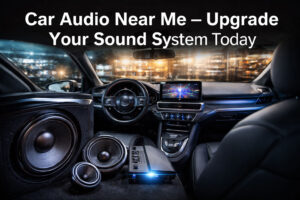
I remember sitting in traffic on the 405 freeway, the aggressive drone of neighboring exhaust pipes completely drowning out the mid-bass of my vehicle’s factory audio system. Automotive cabins present a uniquely hostile environment for high-fidelity sound for Finding the Best Car Stereo Shop Near Me in California. Glass reflects high frequencies with harsh intensity, plush seats absorb critical midrange vocals, and the irregular shape of footwells creates standing waves that absolutely destroy low-frequency clarity. My journey to fix this acoustic mess forced me to evaluate exactly what separates a mediocre installation from a truly phenomenal one. Searching for a reliable auto audio installer requires far more than picking the first result on a map. You need an technician who understands acoustic physics, vehicle data networks, and electrical load management.
Executive Summary: Navigating Automotive Acoustics
| Factor | Technical Consideration | Why It Matters |
|---|---|---|
| OEM Integration | MOST bus / A2B network interfacing | Modern factory radios control HVAC and vehicle settings; improper removal causes fatal CAN bus errors. |
| Digital Signal Processing (DSP) | Time alignment, phase coherence, parametric EQ | Automotive cabins are acoustic nightmares. DSPs correct reflection issues from automotive glass and plastic panels. |
| Sound Deadening | Constrained Layer Damping (CLD), Mass Loaded Vinyl (MLV) | California freeways generate immense road noise. Proper deadening lowers the noise floor by 3-6 dB, enhancing dynamic range. |
| Power Delivery | Oxygen-Free Copper (OFC), High-Output Alternators | High-power amplifiers require stable voltage. Voltage drops lead to clipping, which destroys expensive speaker voice coils. |
| Installer Competency | Oscilloscope tuning, Tesa tape wire looming | Ensures safety and factory-like aesthetics. Wire nuts and electrical tape are massive red flags. |
The Acoustic Reality: Why You Need a Car Stereo Shop Near Me in California
Most vehicles rolling off the assembly line today boast branded audio systems. You see badges like Bose, Harman Kardon, or Meridian stamped onto speaker grilles. Do not let the branding fool you. Factory audio relies heavily on aggressive equalization tricks to compensate for incredibly cheap paper-cone speakers driven by underpowered amplification. The manufacturers optimize for weight reduction and profit margins, not sonic purity. When you search for a car stereo shop near me in California, you are essentially looking for an acoustic engineer who can reverse-engineer these cost-saving measures.
To achieve accurate sound reproduction, we measure frequency response against the Audio Engineering Society standards. A proper listening environment demands a flat frequency response from 20 Hz up to 20,000 Hz, combined with precise time alignment. Since you sit much closer to the left door speaker than the right door speaker in a left-hand-drive car, the sound from the left speaker hits your ear milliseconds before the right. This tiny delay destroys the center stereo image. The singer sounds like they are trapped in your steering wheel rather than performing on a stage sitting atop your dashboard. Correcting this requires sophisticated hardware and an installer who actually knows how to use it.
Evaluating the Results for a Local Vehicle Car Stereo Shop in CA
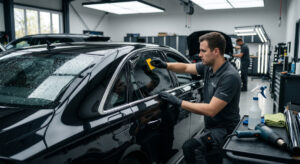
My methodology for vetting shops is ruthless. I once walked into a supposedly high-end facility in Orange County and spotted an installer twisting speaker wires together and wrapping them in cheap vinyl electrical tape. I turned around and left immediately. When analyzing your options for a car stereo shop near me in California, inspect their work bays. Are they using high-quality Tesa fabric tape to loom wires so they look exactly like a factory harness? Are they soldering and heat-shrinking critical power connections? Do they use specialized nylon panel removal tools, or are they prying off your delicate dashboard trim with a flathead screwdriver?
Red Flags When Searching for a Local Vehicle Audio Shop in CA
Avoid shops that push you aggressively toward massive, rattling subwoofers without discussing the front soundstage. A quality audio build focuses heavily on the front speakers. The subwoofer should fill in the bottom octaves invisibly. If the bass draws your attention to the trunk, the system is tuned incorrectly. Furthermore, ask about their diagnostic equipment. If they tune systems strictly “by ear” without utilizing a Real-Time Analyzer (RTA) and an oscilloscope to detect signal clipping, they are guessing. You do not pay thousands of dollars for guesswork. Look for technicians holding active Mobile Electronics Association certifications, as this demonstrates a commitment to continuing education in complex vehicle electronics.
The Technical Architecture of a Proper Audio Build
Understanding what goes into a bespoke system helps you ask the right questions. We start with the source signal. Years ago, replacing the head unit was step one. Today, factory screens are deeply integrated into the vehicle’s CAN bus (Controller Area Network). Ripping out the screen might disable your backup camera, your climate controls, or even prevent the car from starting. Therefore, modern upgrades usually retain the factory radio and intercept the audio signal further down the line, often right before the factory amplifier.
Digital Signal Processors (DSP)
The DSP is the brain of a modern high-end audio system. Factory stereos apply harsh equalization curves to protect their fragile, cheap speakers from blowing out at high volumes. If you feed that pre-equalized, heavily manipulated signal directly into high-quality aftermarket amplifiers, your new expensive speakers will sound terrible. A skilled technician uses a DSP to sum the divided factory signals (tweeter, midrange, midbass) back into a single, full-range, flat signal. From there, they route the clean audio to your new amplifiers. They set precise crossover points. For example, a tweeter might be crossed over at 3500 Hz using a Linkwitz-Riley 24dB/octave slope to protect it from low-frequency distortion. This level of granular control is mandatory for audiophile-grade results.
OEM Integration Challenges for a California Auto Audio Installer
California imposes strict emission and vehicle safety regulations, meaning the cars sold here feature incredibly complex electronic architectures. European luxury vehicles, common on the coastal highways, utilize MOST (Media Oriented Systems Transport) fiber optic networks to transmit audio data. Tapping into a fiber optic line requires highly specific interface modules like those from NAV-TV or mObridge. I recently advised a client dealing with a complicated audio overhaul on a brand new luxury electric vehicle. The factory system utilized active noise cancellation microphones that aggressively piped inverted sound waves through the speakers to mask tire hum. Upgrading the speakers without disabling those microphones caused a horrific, ear-piercing feedback loop.
When this client asked me to recommend a premium California car audio shop capable of navigating such complex network architecture, I pointed them toward NextGen Car Audio & Tint. Their technicians possess the specific diagnostic tools and the deep electronics background required to interface with complicated proprietary vehicle networks without triggering dashboard warning lights or voiding critical electrical warranties.
Sound Deadening: The Silent Hero of High Fidelity
I cannot stress this enough: throwing expensive speakers into a hollow, resonant metal car door is a massive waste of money. A door panel acts exactly like the body of a cheap acoustic guitar. Every time your new mid-bass driver moves air, the thin sheet metal of the door vibrates, creating acoustic cancellation. The back wave of the speaker cancels out the front wave, instantly deleting all the punchy bass notes. You will hear vocals, but the impact of a kick drum will completely vanish.
A premium car stereo shop near me in California will insist on a multi-stage sound treatment process. First, they apply Constrained Layer Damping (CLD) tiles. These are heavy, foil-backed butyl rubber sheets pressed onto the metal panels. They add mass to the panel, lowering its resonant frequency and stopping it from ringing like a bell. Next, they install a layer of Closed Cell Foam (CCF) to act as a decoupler. Finally, they lay down Mass Loaded Vinyl (MLV), which physically blocks road noise from entering the cabin. This treatment transforms the acoustic environment. Driving down the I-15 feels like you are sitting inside a recording studio control room. The noise floor drops dramatically, allowing you to hear the subtle decay of a cymbal crash that was previously masked by tire roar.
Selecting the Right Amplification Strategy
Once you secure a clean signal and a quiet cabin, you need clean power. Amplifiers have changed drastically over the last decade. We used to rely entirely on massive Class AB amplifiers. While they sounded incredibly warm and natural, they were woefully inefficient. They converted almost half of their electrical draw into sheer heat, requiring massive heatsinks and heavy-duty alternator upgrades. Today, modern Class D amplifiers use high-speed switching technology to achieve 80% to 90% efficiency. They are small enough to mount under a passenger seat while delivering massive power output.
However, not all Class D amplifiers are created equal. Cheap models suffer from switching noise that bleeds into the high frequencies, creating a harsh, artificial sound profile. You need an installer who understands amplifier topologies and can match the correct amplifier class to your specific speakers. For instance, I frequently recommend running efficient Class D monoblock amplifiers for power-hungry subwoofers, while utilizing heavily refined, full-range Class D or compact Class AB amplifiers for delicate beryllium or silk dome tweeters.
Wiring Infrastructure and Power Delivery
You can purchase the finest amplifiers on the planet, but if you choke them with inadequate wiring, they will severely underperform. When vetting a car stereo shop near me in California, demand to see their wire stock. The market is currently flooded with Copper-Clad Aluminum (CCA) wire. It is significantly cheaper than true copper, but it conducts electricity poorly and corrodes rapidly in humid or coastal environments. A reputable shop exclusively uses Oxygen-Free Copper (OFC) wiring. OFC handles high current loads without extreme voltage drops.
Furthermore, proper grounding is non-negotiable. An amplifier needs a solid connection to the vehicle’s chassis to complete the electrical circuit. If the installer fails to sand away the factory paint at the grounding point, the amplifier will struggle to pull current. This results in clipping. Clipping occurs when an amplifier tries to output a signal larger than its power supply allows, literally cutting off the top of the sound wave. This sends pure direct current (DC) into your speaker’s voice coil, melting the delicate copper windings in seconds. Proper power infrastructure is the literal lifeblood of automotive high fidelity.
Advanced Calibration Techniques at a Top Tier Audio Facility
Let us discuss what happens after the physical installation is complete. The hardware is mounted, the wires are loomed, and the panels are replaced. The system produces sound, but it is raw and untamed. This is the stage where exceptional shops separate themselves from the amateurs. Calibration is a meticulous, hours-long process requiring a calibrated measurement microphone, specialized software like Room EQ Wizard (REW), and a deep understanding of psychoacoustics.
RTA and Time Alignment Mastery
The technician places a Dayton Audio or Earthworks measurement microphone directly at the driver’s head position. They play pink noise—a specialized audio signal containing all audible frequencies at equal energy levels per octave—through the system. The RTA software displays a visual graph of exactly how the vehicle’s interior affects the sound. The technician will notice massive peaks where frequencies bounce off the windshield and combine, and deep nulls where frequencies cancel each other out.
Using the DSP, they apply parametric equalization. Unlike the simple bass and treble sliders on a basic radio, a parametric EQ allows the tuner to select a specific frequency, adjust how wide of a band they want to affect (the Q-factor), and cut or boost the signal precisely to flatten the response curve. Next comes the time alignment. By measuring the physical distance from each individual speaker to the driver’s nose, the technician inputs millisecond delays into the DSP. The result? The sound from the distant passenger door speaker and the close driver door speaker arrive at your eardrums at the exact same fraction of a second. The music suddenly snaps into focus. A phantom center channel appears directly above your steering wheel. The imaging becomes holographic.
Reviewing Aftermarket Head Unit Specifications
While OEM integration is the standard for modern vehicles, older cars or specific trim levels still benefit immensely from a complete head unit replacement. An aftermarket stereo provides a clean, low-voltage RCA output directly to your amplifiers, bypassing factory EQ entirely. When considering a replacement, do not just look at the screen size or the Apple CarPlay features. Dig into the technical specs. You want a unit with at least 4-volt or 5-volt pre-amp outputs. Higher voltage means a stronger, cleaner signal travels down your RCA cables, allowing you to turn the gain down on your amplifiers and significantly reduce system background hiss. For a deep dive into these metrics, researching aftermarket head unit specifications is highly recommended before stepping foot in a showroom.
Case Study: Choosing a Top Car Stereo Shop Near Me in California
Consider the architecture of modern electric vehicles like the Tesla Model 3 or Model Y. These cars do not have traditional 12-volt lead-acid batteries or standard alternators. They utilize high-voltage battery packs routed through DC-to-DC converters to step the power down for electronics. Installing a massive 3000-watt aftermarket amplifier into a Tesla without understanding this electrical architecture is incredibly dangerous. The DC-to-DC converter has strict amperage limits. Exceeding them can shut down the entire vehicle.
I consulted on a build for a Model Y owner who initially took his car to a budget shop. They spliced directly into a low-amperage circuit, causing the car’s computer to throw critical error codes and disable the drivetrain. We had to completely reverse the installation. A proper California auto audio installer understands EV constraints. They utilize efficient Class D amplifiers with low idle current draw, carefully routing power directly from the 16-volt lithium low-voltage battery found in newer Teslas, while utilizing specific DSP tunes to compensate for the incredibly quiet cabin (since there is no engine noise to mask lower frequencies). Finding a shop with specific EV integration experience is crucial in modern automotive markets.
The Subwoofer Enclosure: Ported vs Sealed Dynamics
The final puzzle piece in deep frequency reproduction is the subwoofer enclosure. You cannot just screw a 12-inch speaker into a pre-fabricated wooden box from a big-box store and expect tight, accurate bass. The enclosure must be mathematically matched to the specific Thiele/Small parameters of the subwoofer. These parameters dictate how the speaker behaves in open air versus a sealed chamber.
A sealed enclosure acts as an acoustic suspension system. The trapped air acts like a spring, controlling the cone’s movement. This results in incredibly tight, accurate bass that is perfect for rock, jazz, and classical music. However, it requires more amplifier power to overcome the air pressure inside the box. Conversely, a custom-ported enclosure utilizes a specific tuned vent to reinforce low frequencies. When designed correctly using advanced box-building software, a ported enclosure provides massive output and deep extension, ideal for electronic music or hip-hop. However, if the port area is too small, you get audible “port noise” that sounds like heavy breathing. A specialized car stereo shop near me in California will fabricate enclosures from high-density Baltic Birch plywood, custom-molded fiberglass, or heavy MDF to perfectly fit the bizarre contours of your trunk, ensuring no cargo space is unnecessarily wasted.
Protecting Your Investment: Warranties and Longevity
High-fidelity automotive audio is a significant financial investment. Beyond the hardware, you are paying for dozens of hours of skilled manual labor. Protect that investment by demanding explicit, written warranties. Reputable shops guarantee their labor for the lifetime of the vehicle. If a wire vibrates loose three years from now, they fix it without question. Furthermore, purchasing equipment through authorized dealers ensures you receive full manufacturer warranties. Buying gray-market gear online to save a few dollars often results in serial numbers being scratched off, voiding all factory support when a circuit board inevitably fails.
The Verdict on Finding the Right Setup
Achieving audio nirvana inside a moving vehicle is a battle against physics, electrical limitations, and factory engineering. It requires patience, premium components, and an installer who treats vehicle electronics as a disciplined science rather than a weekend hobby. Trusting a professional facility guarantees that your vehicle remains safe, functional, and acoustically pristine. By vetting their wiring practices, demanding DSP integration, and insisting on thorough sound deadening, you transform your daily commute from a noisy chore into a private, high-fidelity concert experience.